 Add to Chrome
 Add to Firefox
 Add to Edge
SafeRx-Agent: A Knowledge-Grounded Multi-Agent Framework for Safe and Explainable Medication Recommendation
May 27, 2026
Medication recommendation predicts medications for patient visits, but existing methods still face two key challenges. At the model level, traditional drug recommendation methods only predict structured drug codes with limited evidence grounding, while LLM agents can use richer clinical context but may lack safety verification and traceability. At the task level, existing benchmarks often use broad medication categories, which ignore subgroup-level safety differences and can lead to risk overestimation. We introduce the first fine-grained medication recommendation setting based on fourth-level ATC code generation. We propose Safe Prescription Agent (SafeRx-Agent), a knowledge-grounded multi-agent framework that uses patient context, external clinical knowledge, and safety verification to recommend traceable medication sets. Experimental results on MIMIC-III and MIMIC-IV datasets show that SafeRx-Agent improves fine-grained medication prediction accuracy while controlling drug interactions, contraindications, and medication set size.

Ω-QVLA: Robust Quantization for Vision-Language-Action Models via Composite Rotation and Per-step Scaling
May 27, 2026Vision-Language-Action (VLA) models unify perception, reasoning, and control within a single policy, yet their multi-billion-parameter backbones and diffusion-based action heads make on-device deployment prohibitively expensive. Prior quantization efforts offer only partial solutions, compressing the LLM backbone while leaving the DiT action head at full precision, or resorting to mixed-precision schemes, driven by the belief that uniformly quantizing the action head is inherently unstable. We challenge this assumption with Omega-QVLA, the first training-free post-training quantization framework that compresses both the language backbone and the entire diffusion action head of a VLA model to a uniform W4A4 precision, eliminating the need for mixed-precision allocation. Omega-QVLA combines a composite SVD-Hadamard rotation that equalizes per-channel weight energy while diffusing residual activation outliers with per-step DiT activation scaling quantization that absorbs dynamic-range drift across denoising steps. On LIBERO, Omega-QVLA compresses Pi 0.5 and GR00T N1.5 to W4A4 with 98.0% and 87.8% task success rates, matching or exceeding their FP16 references of 97.1% and 87.0%, while reducing the static memory footprint by 71.3%. Real-world manipulation experiments further confirm smooth, accurate manipulation where prior methods fail. Code is available at https://github.com/UCMP13753/Omega-QVLA.
TARQ: Tail-Aware Reconstruction Quantization for Rare-Word Robust Automatic Speech Recognition
May 27, 2026Data-aware post-training quantization (PTQ) minimizes a per-token reconstruction loss on a small calibration corpus, implicitly weighting positions by their empirical frequency. For \textbf{A}utomatic \textbf{S}peech \textbf{R}ecognition (ASR), this misaligns with tail-sensitive risk: names, numerals, and domain-specific words receive proportionally little calibration mass. We propose \textbf{Tail-Aware Reconstruction Quantization} (\TARQ), a label-free PTQ framework that shifts calibration toward the lexical tail via \textbf{\rareBAL}, a closed-form per-Linear-layer rule equalizing common/tail mass, paired with a metric-consistent residual correction. \TARQ\ requires no entity labels, no curated calibration set, no validation decoding, and no additional training. Across eight ASR backbones and six datasets at W4G128, \TARQ\ improves mean rare-\textbf{W}ord \textbf{E}rror \textbf{R}ate (rare-WER) without an aggregate-WER regression, achieves the lowest cross-corpus rare-WER swing among compared methods, and transfers to entity-rich benchmarks (ProfASR, ContextASR-Speech-En) without entity supervision.
Co-Evolution of Policy and Internal Reward for Language Agents
Apr 03, 2026Large language model (LLM) agents learn by interacting with environments, but long-horizon training remains fundamentally bottlenecked by sparse and delayed rewards. Existing methods typically address this challenge through post-hoc credit assignment or external reward models, which provide limited guidance at inference time and often separate reward improvement from policy improvement. We propose Self-Guide, a self-generated internal reward for language agents that supports both inference-time guidance and training-time supervision. Specifically, the agent uses Self-Guide as a short self-guidance signal to steer the next action during inference, and converts the same signal into step-level internal reward for denser policy optimization during training. This creates a co-evolving loop: better policy produces better guidance, and better guidance further improves policy as internal reward. Across three agent benchmarks, inference-time self-guidance already yields clear gains, while jointly evolving policy and internal reward with GRPO brings further improvements (8\%) over baselines trained solely with environment reward. Overall, our results suggest that language agents can improve not only by collecting more experience, but also by learning to generate and refine their own internal reward during acting and learning.
OJBKQ: Objective-Joint Babai-Klein Quantization
Feb 09, 2026Post-training quantization (PTQ) is widely used to compress large language models without retraining. However, many existing weight-only methods rely on heuristic objectives and greedy rounding, thus leading to noticeable degradation under low-bit quantization. In this work, we introduce OJBKQ (Objective-Joint Babai-Klein Quantization with K-Best Sampling), a layer-wise PTQ method that formulates weight quantization as a joint optimization problem over activations and weights. This formulation results in a multiple-right-hand-side box-constrained integer least squares (BILS) problem in each layer, which is NP-hard. For each column of the weight matrix, we apply an extended Babai nearest-plane algorithm and an extended version of Klein's randomized Babai algorithm to find the minimum-residual Babai-Klein point, a sub-optimal solution to the BILS problem. Experimental results on large language models show that OJBKQ achieves lower perplexity at 3-4 bits compared to existing PTQ approaches, while maintaining comparable computational cost.
InfMem: Learning System-2 Memory Control for Long-Context Agent
Feb 02, 2026Reasoning over ultra-long documents requires synthesizing sparse evidence scattered across distant segments under strict memory constraints. While streaming agents enable scalable processing, their passive memory update strategy often fails to preserve low-salience bridging evidence required for multi-hop reasoning. We propose InfMem, a control-centric agent that instantiates System-2-style control via a PreThink-Retrieve-Write protocol. InfMem actively monitors evidence sufficiency, performs targeted in-document retrieval, and applies evidence-aware joint compression to update a bounded memory. To ensure reliable control, we introduce a practical SFT-to-RL training recipe that aligns retrieval, writing, and stopping decisions with end-task correctness. On ultra-long QA benchmarks from 32k to 1M tokens, InfMem consistently outperforms MemAgent across backbones. Specifically, InfMem improves average absolute accuracy by +10.17, +11.84, and +8.23 points on Qwen3-1.7B, Qwen3-4B, and Qwen2.5-7B, respectively, while reducing inference time by $3.9\times$ on average (up to $5.1\times$) via adaptive early stopping.
Beyond Hard Writes and Rigid Preservation: Soft Recursive Least-Squares for Lifelong LLM Editing
Jan 22, 2026Model editing updates a pre-trained LLM with new facts or rules without re-training, while preserving unrelated behavior. In real deployment, edits arrive as long streams, and existing editors often face a plasticity-stability dilemma: locate-then-edit "hard writes" can accumulate interference over time, while null-space-style "hard preservation" preserves only what is explicitly constrained, so past edits can be overwritten and unconstrained behaviors may deviate, degrading general capabilities in the many-edits regime. We propose RLSEdit, a recursive least-squares editor for long sequential editing. RLSEdit formulates editing as an online quadratic optimization with soft constraints, minimizing a cumulative key-value fitting objective with two regularizers that control for both deviation from the pre-trained weights and from a designated anchor mapping. The resulting update admits an efficient online recursion via the Woodbury identity, with per-edit cost independent of history length and scaling only with the current edit size. We further provide deviation bounds and an asymptotic characterization of the adherence-preservation trade-off in the many-edits regime. Experiments on multiple model families demonstrate stable scaling to 10K edits, outperforming strong baselines in both edit success and holistic stability -- crucially retaining early edits, and preserving general capabilities on GLUE and held-out reasoning/code benchmarks.
MARS: Unleashing the Power of Speculative Decoding via Margin-Aware Verification
Jan 21, 2026Speculative Decoding (SD) accelerates autoregressive large language model (LLM) inference by decoupling generation and verification. While recent methods improve draft quality by tightly coupling the drafter with the target model, the verification mechanism itself remains largely unchanged, relying on strict token-level rejection sampling. In practice, modern LLMs frequently operate in low-margin regimes where the target model exhibits weak preference among top candidates. In such cases, rejecting plausible runner-up tokens yields negligible information gain while incurring substantial rollback cost, leading to a fundamental inefficiency in verification. We propose Margin-Aware Speculative Verification, a training-free and domain-agnostic verification strategy that adapts to the target model's local decisiveness. Our method conditions verification on decision stability measured directly from the target logits and relaxes rejection only when strict verification provides minimal benefit. Importantly, the approach modifies only the verification rule and is fully compatible with existing target-coupled speculative decoding frameworks. Extensive experiments across model scales ranging from 8B to 235B demonstrate that our method delivers consistent and significant inference speedups over state-of-the-art baselines while preserving generation quality across diverse benchmarks.
Dynamic Quantization Error Propagation in Encoder-Decoder ASR Quantization
Jan 05, 2026Running Automatic Speech Recognition (ASR) models on memory-constrained edge devices requires efficient compression. While layer-wise post-training quantization is effective, it suffers from error accumulation, especially in encoder-decoder architectures. Existing solutions like Quantization Error Propagation (QEP) are suboptimal for ASR due to the model's heterogeneity, processing acoustic features in the encoder while generating text in the decoder. To address this, we propose Fine-grained Alpha for Dynamic Quantization Error Propagation (FADE), which adaptively controls the trade-off between cross-layer error correction and local quantization. Experiments show that FADE significantly improves stability by reducing performance variance across runs, while simultaneously surpassing baselines in mean WER.
Incorporating Spatial Information into Goal-Conditioned Hierarchical Reinforcement Learning via Graph Representations
Nov 14, 2025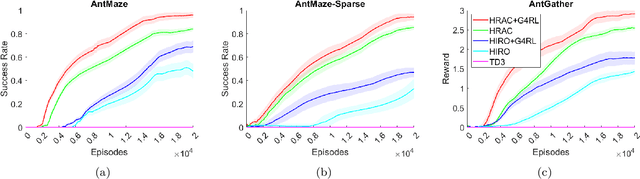
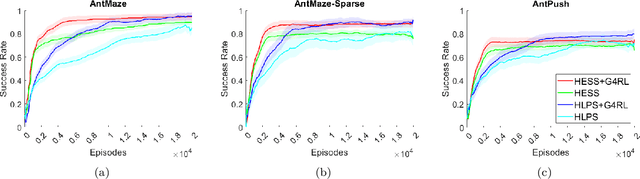
The integration of graphs with Goal-conditioned Hierarchical Reinforcement Learning (GCHRL) has recently gained attention, as intermediate goals (subgoals) can be effectively sampled from graphs that naturally represent the overall task structure in most RL tasks. However, existing approaches typically rely on domain-specific knowledge to construct these graphs, limiting their applicability to new tasks. Other graph-based approaches create graphs dynamically during exploration but struggle to fully utilize them, because they have problems passing the information in the graphs to newly visited states. Additionally, current GCHRL methods face challenges such as sample inefficiency and poor subgoal representation. This paper proposes a solution to these issues by developing a graph encoder-decoder to evaluate unseen states. Our proposed method, Graph-Guided sub-Goal representation Generation RL (G4RL), can be incorporated into any existing GCHRL method when operating in environments with primarily symmetric and reversible transitions to enhance performance across this class of problems. We show that the graph encoder-decoder can be effectively implemented using a network trained on the state graph generated during exploration. Empirical results indicate that leveraging high and low-level intrinsic rewards from the graph encoder-decoder significantly enhances the performance of state-of-the-art GCHRL approaches with an extra small computational cost in dense and sparse reward environments.